
Desserts
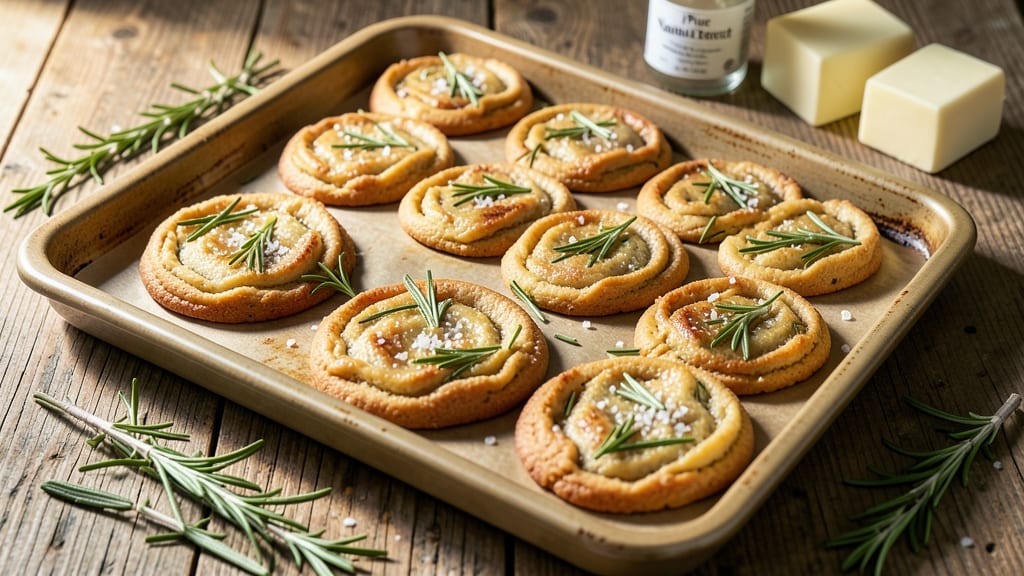
This rosemary cookies recipe transforms a classic dessert into an aromatic, buttery masterpiece with unexpected herbal depth. The combination of fresh rosemary and vanilla swirls creates a sophisticated flavor profile that elevates simple cookies to something extraordinary.
I developed this recipe after discovering how well rosemary complements sweet baking—its piney notes cut through the richness while adding an elegant complexity.
The process is straightforward yet precise: creaming butter and sugar, incorporating rosemary-infused vanilla, and rolling the dough in rosemary before baking. Chilling the dough ensures perfect texture—crisp edges with tender centers—while the vanilla swirls add a luxurious touch.
These cookies bake up golden and fragrant, with just enough herbal bite to balance the sweetness.
What makes these cookies truly special is their versatility. Serve them warm with a dusting of powdered sugar for an elegant dessert, or pair with a cup of chai for a sophisticated afternoon treat.
The rosemary’s aroma lingers beautifully, making these cookies ideal for holiday gatherings or as a unique gift.
With just a few extra steps—like toasting the rosemary and chilling the dough—you’ll achieve professional-quality results every time. The recipe scales easily, so you can bake a single batch for personal indulgence or double it for sharing. Let’s get baking!
Ingredients for rosemary cookies
Fresh rosemary and vanilla elevate these cookies from ordinary to extraordinary with just twelve ingredients.
| Ingredient | Amount | Notes |
|---|---|---|
| Unsalted Butter 🧈 | 1 cup | Cold, cubed for creaming |
| Granulated Sugar 🍚 | 1 cup | Superfine preferred for smooth texture |
| Light Brown Sugar 🍚 | ½ cup | Packed, for moisture |
| Large Eggs 🥚 | 2 whole | Room temperature for blending |
| Pure Vanilla Extract 🍯 | 1 tbsp | High-quality, Madagascar preferred |
| All-Purpose Flour 🌾 | 2 ½ cups | Sifted for lightness |
| Baking Powder 🧂 | 1 tsp | Aluminum-free for best rise |
| Diamond Crystal Kosher Salt 🧂 | ½ tsp | Fine grain for even distribution |
| Fresh Rosemary 🌿 | ¼ cup | Finely chopped, stems removed |
| Powdered Sugar 🍚 | ½ cup | For dusting, plus extra |
| Vanilla Bean Paste 🍯 | 1 tbsp | For swirls, optional but recommended |
| Heavy Cream 🥛 | ¼ cup | Cold, for dough rolling |
The rosemary is non-negotiable for authentic flavor—farmers' market sprigs yield the most aromatic leaves. Toast it lightly in a dry skillet for 30 seconds before chopping to deepen its piney notes. Whole Foods or specialty markets carry the freshest varieties, but even grocery store rosemary works if it's vibrant green with no wilting. For the butter, Plugrá or Land O'Lakes unsalted brands provide consistent texture. The vanilla extract should be pure, with no artificial additives—Madagascar Bourbon offers the richest flavor profile. Pre-sift your flour to eliminate lumps, which ensures a tender crumb.
No fresh rosemary? Dried rosemary at half the amount works, but toast it first to revive its aroma. Substitute vanilla bean paste with imitation vanilla in a pinch, though the flavor will be less complex. For a nutty twist, replace 0.25 cup of flour with finely ground almond flour. The powdered sugar can be swapped for confectioners' sugar, but avoid pre-sweetened versions. If you lack heavy cream, chilled half-and-half works too, though the dough may be slightly less cohesive. For a gluten-free adaptation, use a 1:1 flour blend like King Arthur Measure for Measure.
Store freshly baked cookies in an airtight container at room temperature for up to 5 days, though they'll lose their crispness after 2 days. For longer storage, freeze dough balls on a tray before transferring to a sealed bag for 3 months. Reheat baked cookies at 300°F for 5 minutes to restore crispness. These cookies pair beautifully with chilled chamomile tea or a glass of dry Riesling—the herbal notes complement the wine's acidity perfectly. Double the recipe for holiday gifting; wrap in parchment-lined boxes tied with twine for an elegant presentation.
Why You'll Love This Recipe
- These work everywhere: gift boxes for coworkers, a last-minute cookie swap, or just a plate of warm cookies while you watch a movie. Freeze half the batch, and you’ve got a 30-second treat for months.
- No-Fuss Dough: I swear, this dough comes together in five minutes—just cream butter and sugars, crack eggs, fold in rosemary. No food processor, no overmixing, just a soft, fragrant pile ready for baking. Honestly, it’s the kind of recipe that makes me feel like I’ve earned my afternoon coffee.
- Herb-Packed Magic: That rosemary isn’t just for show—it’s bright and piney, cutting through the sweetness like a little herbal whisper. The vanilla ties it all together, but the butter? Rich enough to make these taste like a hug from a bakery. (Yes, even on a Tuesday night.)
- Holiday or Snack Attack: These work everywhere: gift boxes for coworkers, a last-minute cookie swap, or just a plate of warm cookies while you watch a movie. Freeze half the batch, and you’ve got a 30-second treat for months.
Step-by-step instructions for rosemary cookies recipe
Master the balance of herbal depth and buttery sweetness with these precise techniques.
Cream Butter and Sugars for Maximum Air Incorporation
In a stand mixer fitted with the paddle attachment, combine the 1 cup unsalted butter (cold and cubed) with the 1 cup granulated sugar and 0.5 cup light brown sugar. Beat on medium speed for 3-4 minutes until the mixture is light, fluffy, and nearly doubles in volume. The texture should be pale and ribbon-like when you lift the paddle.
This creaming process is critical—it incorporates air that will create those signature crackly tops. If the butter isn't cold enough, the mixture will separate. If it's too cold, it won't emulsify properly. You'll know you've achieved the perfect consistency when the mixture holds soft peaks when the paddle is lifted.
Add Eggs and Vanilla for Rich Flavor Development
Add the 2 whole large eggs (room temperature) one at a time, mixing on low speed for 30 seconds after each addition until fully incorporated. Then add the 1 tablespoon pure vanilla extract and 1 tablespoon vanilla bean paste, mixing for another 10 seconds until smooth.
The vanilla bean paste adds those visible swirls while deepening the vanilla flavor. Here's the thing—don't overmix. The dough will come together when you add the dry ingredients, but you want to preserve that airy texture from the creaming step. If the mixture looks slightly curdled after adding the eggs, that's normal and will resolve itself in the next step.
Incorporate Dry Ingredients and Rosemary for Herbal Balance
In a separate bowl, whisk together the 2.5 cups all-purpose flour, 1 teaspoon baking powder, and 0.5 teaspoon diamond crystal kosher salt. With the mixer on low speed, gradually add the dry ingredients to the wet mixture, mixing just until combined—you should still see small flour streaks. This prevents overdevelopment of gluten, which would make the cookies tough.
Remove the bowl from the mixer and gently fold in the 0.25 cup finely chopped fresh rosemary using a silicone spatula. The rosemary should be evenly distributed throughout the dough. I know it seems like a lot of herb for cookies, but trust me—the aroma and flavor will be subtle yet distinctive. If you're concerned about the texture, pulse the rosemary in a food processor before adding it to minimize any potential grit.
Chill the Dough for Optimal Texture
Divide the dough into two equal portions, flatten each into a disk, wrap tightly in plastic wrap, and refrigerate for at least 2 hours or up to 24 hours. This chilling step is non-negotiable—it allows the flour to fully hydrate, prevents excessive spreading in the oven, and develops the flavors.
Cold dough also means the cookies will hold their shape better during baking, resulting in thicker cookies with crisp edges and a tender interior. If you're short on time, you can freeze the dough disks for up to 1 month—just add 10 minutes to the baking time when you're ready to bake.
Roll, Cut, and Bake for Perfect Crispness
Preheat your oven to 350°F and line two baking sheets with parchment paper. On a lightly floured surface, roll one disk of dough to ¼-inch thickness. Using a 2.5-inch round cutter, cut out cookies and place them 2 inches apart on the prepared baking sheets. Gather the scraps, reroll, and cut additional cookies.
Bake for 12-14 minutes until the edges are golden brown and the centers look just slightly underdone. They'll continue cooking on the hot sheet after removal. Rotate the baking sheets halfway through for even baking. Remove from the oven and let cool on the sheets for 5 minutes before transferring to a wire rack.
Dust with Powdered Sugar for Final Presentation
While the cookies are still warm, dust the tops generously with 0.5 cup powdered sugar using a fine-mesh sieve. This creates that signature snowy finish while adding a touch of sweetness to complement the herbal notes. For extra presentation, you can also drizzle with a simple vanilla glaze made by mixing 1 tablespoon powdered sugar with 1 teaspoon heavy cream.
Serve immediately while still warm for the ultimate experience—each bite should deliver a perfect balance of buttery richness, herbal rosemary aroma, and sweet vanilla swirls. Store in an airtight container at room temperature for up to 5 days, though they rarely last that long in most households.
Pro Tips For Making Rosemary Cookies
- Cream Butter Slowly: I used to dump cold butter straight into the sugar mix and end up with a dough that fought me every step. Instead, let the butter sit at room temperature for 30 minutes first, then beat it with the sugars on medium-high until the mixture looks like wet sand—not greasy, not dry. That’s when the flavor really develops.
- Toast the Rosemary: Skip the fresh rosemary straight from the jar—it’ll turn your dough bitter. Pulse 1 tablespoon of fresh sprigs in a spice grinder for 5 seconds, then toast them in a dry skillet over medium heat for 30 seconds until fragrant. Let cool completely before mixing into the dough, or you’ll end up with a sad, under-flavored batch.
- Don’t Overmix the Dough: I learned this the hard way—after kneading rosemary cookies dough for what felt like forever, my cookies turned out dense and chewy. Mix the wet and dry ingredients just until combined, then fold in the rosemary by hand. Overmixing develops gluten, and these cookies should be tender, not tough.
- Chill the Dough Twice: Yes, even if you’re impatient like me. First, chill the dough for 30 minutes after mixing to firm it up. Then, after scooping balls, freeze them on a tray for 10 minutes before baking. This prevents spreading and ensures even baking—no more flat, sad cookies that look like they collapsed mid-bake.
Wine and beer pairings for this rosemary cookies
Herbal Wine Pairings
These rosemary cookies pair beautifully with dry white wines that complement their herbal notes. A Sauvignon Blanc from New Zealand—like Cloudy Bay—works wonderfully, with its crisp acidity and citrus undertones balancing the rosemary’s piney aroma.
The wine’s bright finish cuts through the cookies’ buttery richness, creating a refreshing contrast. 🍷
For a bolder match, try a dry Riesling from Germany’s Mosel region. The wine’s natural sweetness and mineral notes harmonize with the vanilla swirls while the rosemary’s herbal complexity shines through. Serve slightly chilled (50-55°F) to enhance both flavors.
Craft Beer Complements
If you prefer beer, a Belgian witbier like Stella Artois Wit is a fantastic choice. Its coriander and orange peel notes create a delightful interplay with the rosemary’s herbal depth and the vanilla’s sweetness. The beer’s effervescence also cleanses the palate between bites. 🍺
For a richer option, try a honey blonde ale such as Allagash White. The honeyed maltiness enhances the cookies’ caramelized edges, while the subtle herbal notes in the beer mirror the rosemary’s aroma. Serve at 45-50°F to preserve the beer’s crispness.
Coffee Contrast
For an after-dinner treat, pair these cookies with a medium-roast coffee brewed with chamomile-infused water. The floral notes of chamomile echo the rosemary’s herbal profile, while the coffee’s bitterness balances the sweetness. I like a light French roast from Intelligentsia Coffee for its smooth, aromatic finish.
If you prefer espresso, try a cortado—the creamy milk softens the coffee’s intensity, making it a perfect match for the cookies’ buttery texture. The rosemary’s aroma lingers beautifully with the coffee’s warmth, creating a sophisticated pairing. ☕
Herbal Tea Harmony
A rosemary-infused Earl Grey tea elevates the experience by doubling down on the herbal theme. The bergamot in Earl Grey adds a citrusy brightness that complements the rosemary’s piney notes. Brew with hot water at 200°F for 4-5 minutes to avoid bitterness. 🌿
For a caffeine-free option, hibiscus tea with a splash of lemon juice creates a tart contrast that highlights the cookies’ sweetness. The tea’s vibrant color and floral notes make it a visually stunning accompaniment to the golden-brown cookies.
Nutrition facts
Frequently asked questions
Can I substitute dried rosemary for fresh in these cookies?
Yes, but use only half the amount (about 1.5 teaspoons dried). Toast the dried rosemary in a dry skillet for 1 minute to intensify its flavor before grinding it finely. Fresh rosemary has a brighter aroma, but dried works well if you don't have fresh sprigs.
Why do I need to chill the dough for these cookies?
Chilling the dough for at least 2 hours is essential for three reasons: it prevents excessive spreading, allows flavors to meld, and creates a crispier texture. The cold butter solidifies slightly, giving you thicker cookies with defined edges. Skipping this step often results in flat, cake-like cookies instead of the perfect crunch you want.
How can I make these cookies gluten-free?
Replace the all-purpose flour with a 1:1 gluten-free baking flour blend (like King Arthur Measure for Measure) and add ½ teaspoon xanthan gum if your blend doesn't contain it. You may also need to increase the egg to 3 total for better structure. Keep all other ingredients exactly the same, including the chilling time. The texture will be slightly denser but still delicious.
Can I make the dough ahead of time?
This dough freezes beautifully. After chilling, wrap the dough disks tightly in plastic wrap and freeze for up to 1 month. Thaw in the refrigerator overnight before baking. When ready to bake, add 10-12 minutes to the baking time since frozen dough takes longer to heat through. This makes perfect holiday gifts!
What's the secret to getting those perfect crackly tops?
The crackly tops come from proper creaming of the butter and sugar (beat until pale and fluffy) and baking at the correct 350°F. For extra crackle, place cookies on a baking sheet with a parchment-lined tray underneath to reflect heat. Also, avoid opening the oven door during the first 10 minutes of baking—this causes them to collapse.